
If you're shopping for marketing help, the word "boutique" turns up fast. Nobody defines it, and nobody polices it. A four-person shop uses it. So does a three-hundred-person agency with a nice lobby.
I'm Evan, the founder of Ernst Media. We're seven people in Spokane, Washington, running paid media and search, so I have an obvious stake in the answer. I'll try to be useful anyway.
By the end of this article you'll know:
- What the term means, and what it doesn't guarantee
- How a boutique agency differs from a full-service agency and from a freelancer
- How boutique pricing is structured, and which structures create bad incentives
- When a boutique agency is the wrong choice
- The questions to ask before you sign anything
What is a Boutique Marketing Agency?
A boutique marketing agency is a small marketing firm, usually fewer than 50 people and often fewer than ten, that specializes in a few services instead of offering everything. Clients work directly with the senior people doing the work. The roster is short on purpose, and there's no account management layer between you and your campaigns.
That's the honest definition. Here's what the word doesn't tell you.
It isn't a credential. No one issues it. An agency can call itself boutique the morning it decides to.
It doesn't mean cheap. A small team often costs more per hour than a big agency's junior staff, because the person on your account is senior. What you're buying is attention, not a discount.
It doesn't mean specialized by itself. Plenty of small agencies still sell every service on the menu. A small generalist is just a small generalist.
So the useful questions are about structure, not vocabulary. Who touches the account? How many accounts does that person carry? What does the agency refuse to do? Those are further down.
Most Agencies Are Already Small
A recent digital agency industry report by Promethean Research estimates the following distribution of digital marketing companies in the US:
- Small firms with 1-10 employees make up 64%
- Companies in the 11-50 employee range are 27%
- Larger agencies with more than 50 employees are just 9%
The boutique model is the norm, not the exception. According to Statista, more than 54,000 advertising agencies offer digital services in the US, and the large majority of them are small teams. That also means "boutique" describes tens of thousands of very different companies. I can only speak with certainty about how my own team works, so where I describe a process below, I'm describing ours.
Boutique vs. Full-Service Agency
This is the comparison most people are actually making. Large agencies are capable of excellent work. The difference isn't talent, it's structure, and structure decides what you get on a Tuesday afternoon.
What a Full-Service Agency Gives You
- Breadth under one roof. Website, brand, PR, media buying, video production, all on one invoice.
- Bench depth. If someone quits, someone else picks it up. A small team feels that departure much harder.
- Capacity for a spike. A launch that needs six people for three weeks is a staffing problem a big agency can solve and a small one usually can't.
- Procurement fit. Larger vendors are set up for security reviews, insurance thresholds, and master service agreements.
What a Boutique Agency Gives You
- Direct contact with the person doing the work. No salespeople, no account managers relaying your question to someone you've never met.
- Faster decisions. Fewer layers means a change gets made the day it's agreed to, not after it clears an internal review.
- Senior hands on a small account. At a large firm, a small budget is often assigned to junior staff. At a small firm there's no junior bench to hand it to.
- A short client roster. Fewer accounts per strategist means more hours of thought per account.
- Less outsourcing. Small teams tend to keep work in-house, largely because there's no one to hand it off to.
Boutique vs. Freelancer
The other real option, and the one people skip past. A freelancer is one person. That's the cheapest arrangement and the most flexible, and it comes with no redundancy. A vacation, an illness, or a busy month is now your problem. One person also rarely covers paid search, paid social, SEO, and analytics at a senior level, because those are different jobs.
A boutique agency is several specialists with shared coverage and a process that survives one person being out.
If you need one well-defined channel run and you're able to manage the relationship yourself, a good freelancer may be the better buy. Don't pay agency rates for a job one person can do.
How a Boutique Marketing Agency Works

Partnering with a boutique agency means the people planning your digital marketing strategy are the same people executing it. Here's the shape of it at Ernst Media.
1. A call with a person who can decide things. You book a free call with me or my brother Nick, the CEO. We talk about your business, what you've already tried, and what you're measuring. If we're not the right fit, that's the call where I say so.
2. A plan tied to your budget, not our menu. We pick the channels that suit the business. Some accounts don't need everything we sell, and saying that out loud is cheaper for you than finding out in month four.
3. A standing cadence on the numbers. You get regular check-ins and reporting on the KPIs that matter, in plain language, so adjustments happen on evidence rather than on a hunch.
Two structural details matter more than the meetings. You own the ad and analytics accounts, which means you can leave and take everything with you. And there's no contract, so the arrangement is renewed by you every month.
How Boutique Agency Pricing is Structured
Pricing models differ more than most agency websites admit, and each one creates a different incentive. Learn to read them.
Percentage of ad spend. The agency earns more when you spend more. It works right up to the day cutting your budget is the correct move.
Flat monthly retainer. Predictable for both sides. You pay the same in a slow month and a heavy one, and eventually somebody has to argue about scope.
Hourly. You pay for work that happened. It only works if the agency will show you the hours, so ask to see them itemized before you agree to it.
Per project. Good for a defined build with an end date. Poor for channels that need attention every week.
Commission or performance-based. Rare, and usually messy. Attribution disputes arrive the first month results are ambiguous.
At Ernst Media it's a flat $95 an hour for every service, month to month, no contract, and never a percentage of your spend. If trimming your budget improves your results, we have no financial reason to argue. Our minimum ad spend is $500 a month, because below that there isn't enough data to manage against. I won't quote you a monthly figure here, because hours depend on the account, not on the budget. The full argument, including what the model costs you, is on the Why Ernst Media page.
When a Boutique Agency is the Wrong Choice
Any agency that can't answer this question is selling, not advising. A boutique is the wrong call when:
- You need many disciplines at once. A website build, a brand identity, packaging, PR, and a video shoot in the same quarter is a job for a full-service shop. We don't build websites or do brand design, and we'll point you to people who do.
- You need coverage a small team can't staff. Multiple time zones, weekend monitoring, or hundreds of local accounts updated daily.
- Procurement requires a large vendor. If your company needs a formal security review, a dedicated account team, and a signed master agreement before anyone opens an ad account, small firms will lose that process on paperwork alone.
- You want a dedicated account manager. Some teams genuinely prefer one point of contact who handles the relationship. That's a real preference, and it's the opposite of this model.
- You want the lowest possible hourly rate. Offshore and junior teams will beat a senior small team on price. That's a legitimate trade if you have the in-house expertise to direct them.
- Your ad budget is under the floor. Below $500 a month there isn't enough signal to optimize. Spend the money on the ads and revisit management later.
- You want a single vendor to hold accountable for everything. A specialist agency is one piece of your marketing, not all of it.
What to Expect From a Boutique Marketing Agency
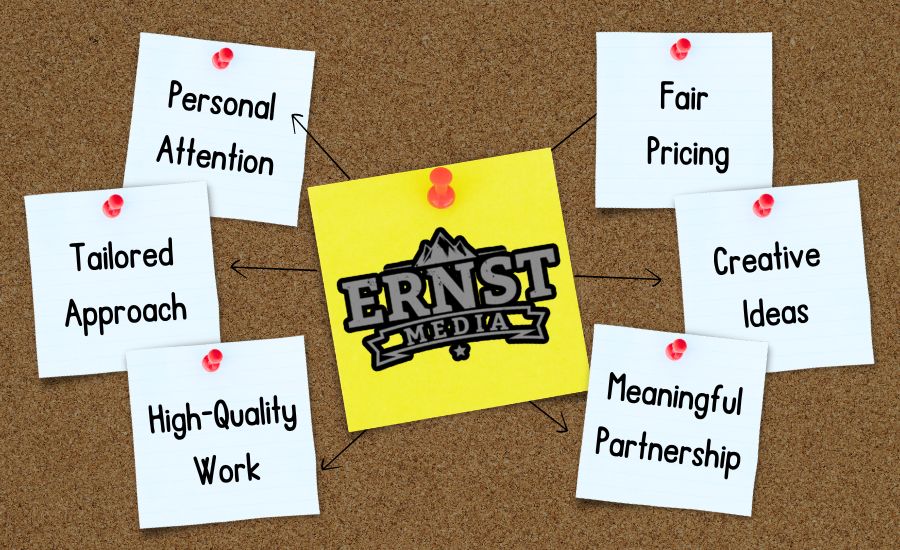
Direct Access
You email the strategist, not a queue. At Ernst Media we take the time to answer digital marketing questions from small business owners even when the answer is "you don't need us for that."
Work Built For Your Account
Nothing here is a template. Boutique firms account for your industry, your margins, and who you're actually trying to reach, and they change the plan when the data says to.
Fewer Clients Per Strategist
A short roster is the whole point. Every account gets senior attention because there's no one else to give it to. Client stories are on our work page if you want to see what that looks like in practice.
Long Relationships, Not One-Off Projects
Small agencies tend to seek partnerships rather than transactions, because a short roster only works if clients stay. Month-to-month terms make that a monthly decision instead of an annual one.
Pricing You Can Audit
Most boutique companies, including us, don't sell preset packages. You pay for the work that's needed, which means the invoice should be something you can check line by line.
The Questions to Ask Before You Sign
Ask these of any agency, boutique or not. Vague answers are answers.
- Who will run my account day to day, and how many other accounts do they carry?
- Do I own the ad and analytics accounts? Get it in writing.
- How am I billed, and can I see the hours or the work log?
- What do you refuse to do?
- What happens when the person on my account is out for two weeks?
- What does month one look like, and what does the first report contain?
- Can I leave, and what do I take with me when I do?
- Show me an account like mine. What did you change first, and what did you deliberately leave alone?
That last one separates operators from presenters. Anyone can describe a strategy. Fewer can tell you what they chose not to touch and why.
The Short Version
A boutique marketing agency is a small, specialized team that trades scale for senior attention. If your marketing needs deep work in a few channels and you want to talk to the person doing it, that structure is hard to beat. If you need breadth, bench depth, or a vendor built for procurement, it isn't the right shape, and no amount of personal attention fixes that.
Our team focuses on a short list of services: paid search, paid social, SEO, and AI search. If that's what you need, I'd be happy to learn more about your business and tell you honestly whether we're the right fit.


Founder of Ernst Media. Fifteen years running paid search and paid social for small and mid-size businesses, and still the person who builds the audits by hand. Writes here about what actually moves accounts.