
If you're an SMB owner investing time and money into digital marketing, you're doing the right thing....Have no doubts about it.
So, you have a defined strategy, launched a few campaigns, and you want to know:
How is digital marketing performance measured?
There are a bunch of metrics and KPIs used to evaluate digital marketing efforts. But you have a business to run...And since you landed on this page, I assume you're not a professional marketer.
So, we'll focus on the 5 most important digital marketing KPIs for small businesses.
- Website Traffic
- Conversion Rate
- Cost Per Acquisition/Lead
- Customer Lifetime Value
- Return on Investment
My name is Evan. I run a Boutique Marketing Agency, and will explain the 5 essential KPIs in a simple way...Just like I do to our clients at Ernst Media. Let's go over the basics real quick.
What Are Digital Marketing KPIs?
Key performance indicators (KPIs) are measurable numbers that evaluate a specific action. They're a compass that navigates you through the sea of digital marketing, showing the distance to your goals.
KPIs are NOT:
"Nice to Know Digital Marketing Metrics" or "Interesting to Look at Reports"
Why Are Marketing KPIs Important for Your Business?
When you understand how to track the right KPIs, you can align them with financial metrics. This will allow you to make data-driven decisions. Then, you'll be able to increase the impact of your digital marketing strategies on your business's success.
Making decisions based on assumptions is one of the biggest digital marketing mistakes.
I've been helping SMB owners scale for many years...And yes, as your small business grows, your capabilities and goals will change. Naturally, you'll have to keep track of more KPIs, but you may already have a marketing team for that.
So, for now...let's stick with the essential small business KPIs.
Key Performance Indicators for Small Businesses
As you already know, we'll be talking only about 5 indicators. Each digital marketing KPI will help you track your advertising buck and see which tactics are turning browsers into spenders. I'll also give you tips on how to improve some metrics and KPIs.
“If you’re not measuring, you’re just practicing”
That's a favorite quote of mine from Bob Parsons. I often use it when consulting small business owners so they don't forget to evaluate digital marketing channels.
Website Traffic
It all starts with your website traffic, and it's not just about how many people land on your site. Digital marketing metrics like unique visitors and traffic sources will tell you a lot about the effectiveness of your online marketing campaigns.
So, look at your:
- Direct visits
- Organic reach
- Social media referrals
- Paid traffic from ads
These insights will give you an idea of which channels are yielding the best results...And where to allocate more of your online advertising budget later on.
Next, dive into page views per session, average time on page, and device type. These digital marketing metrics will reveal how users feel about your site.
Not paying attention to user experience may result in low-quality ad scores when promoting your business on Google. It's also one of the common reasons why SEO doesn't work.
And...it will negatively impact conversion rates.
Conversion Rate
Conversion rate is the percentage of visitors who engage in a meaningful way. I'm talking about making a purchase, signing up for a newsletter, or taking other actions that move them to the next stage of your marketing funnel.
This digital marketing KPI measures the success of your online efforts by showing customer actions in response to different campaigns.
A recent report by First Page Sage shows the average conversion rates for each digital marketing channel in 2026. The numbers are shown in the image below.
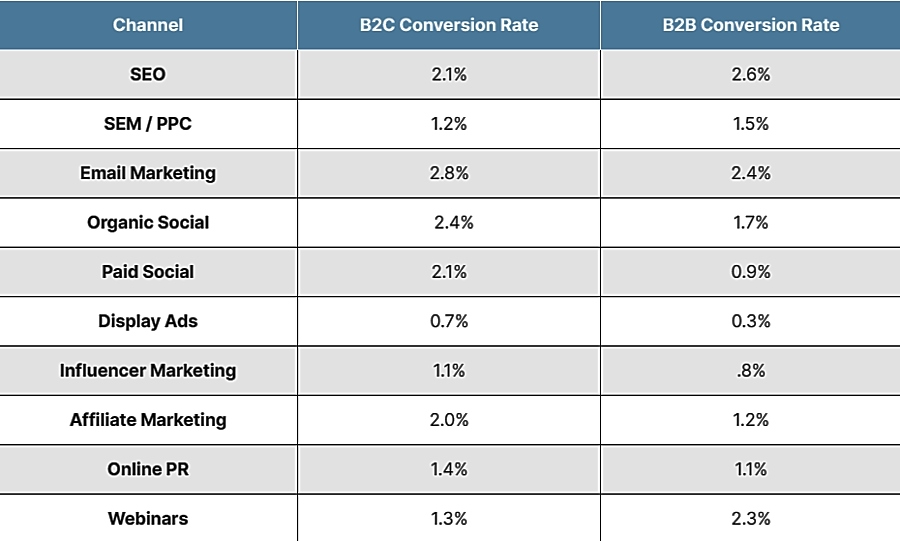
Here is what we do at Ernst Media if conversion rates are below the average:
- A/B split testing to compare different versions of landing pages or ad copies
- Adding clearer and more compelling calls to action at prominent areas of the site
- Incorporating customer testimonials and addressing pain points within the content
Cost Per Lead/Customer Acquisition
We've worked with big companies that spend six figures monthly without considering those indicators. However, digital marketing KPIs like Cost Per Lead (CPL) and Customer Acquisition Cost (CAC) are highly important for any small business owner.
- CPL helps you gauge the efficiency of lead-generation efforts
- CAC shows you the cost associated with acquiring new customers
Calculating these metrics is relatively easy: divide your total campaign spend by the number of leads or customers acquired to get CPL or CAC, respectively.
If you utilize Google ads for your SMB, these KPIs can be seen in Google Analytics.
These numbers are a barometer for how well your marketing initiatives are performing in terms of profitability...And based on my 20 years as a digital marketer, there is always room for improvement.
Let me give you a couple of examples:
Having a live chat or offering free trials on your site can generate high-quality leads for free.
For paid search campaigns, you can bid on cheaper keywords or not compete for the top spot.
But lowering the CPL and CAC isn't the end of the story. These marketing KPIs must be measured against the customer lifetime value (CLV) to fully understand their impact on your business goals.
Simply put, if the lead or new customer acquisition costs are less than the sales revenue you generate over time...You’re doing a good job.
Customer Lifetime Value
Obviously, this KPI isn’t limited to a single transaction. It's the total profit your SMB can anticipate from a customer throughout your relationship. There are two types of CLV:
- Historic - focusing on past spending behaviors
- Predictive - forecasting your future revenues
The first will help you better manage operating and marketing expenses. The second will tell you how to maximize the net profit margin from potential customers. In other words, these KPIs allow you to run data-driven digital marketing campaigns.
So, what's a good CLV in digital marketing?
A marketing rule of thumb is that your CLV to CAC ratio should be 3:1. Anything significantly different from that means you need to spend less or more.
If it's lower, it's time to invest in customer retention strategies:
- Create an attractive loyalty program
- Offer appealing packages or upgrades
- Build a community around your brand
If it's higher, you might be missing out on potential revenue:
- Take full advantage of Search Engine Marketing
- Utilize new Social Media channels for brand awareness
Return on Investment
Ultimately, everything culminates in the Return on Investment. Some digital marketers say ROI isn't a KPI, but if you ask me...It sure is, and it's the most important of all.
At the end of the day, your business performance is measured by how much money you make.
ROI is a key performance indicator for the effectiveness of your digital marketing strategies. It shows you how much profit is generated for every dollar spent, and then some...
- It demonstrates the value of your marketing efforts
- It tells you how much marketing contributes to growth
- It shows you how to advertise your biz more efficiently
To calculate your ROI, divide your profit by the cost and multiply by 100 to get the percentage.
When managing PPC campaigns for clients, for example, we aim at 4-5x return on advertising spend (ROAS). Sometimes, we get an ROI as good as 7 or 8:1 from other marketing channels.
For starters, try to get at least 3-4 x return on your marketing spending. Then, keep looking for ways to optimize your digital marketing metrics, which will increase your ROI.
If you run any ad campaigns and want a certified expert to examine your marketing performance and make recommendations for improvement...Now is your chance.
We're accepting limited applications for 100% Free Audits
My Final Thoughts
If you run a small business without a marketing team, it's easy to get lost in a sea of data. Get comfortable with the essential digital marketing metrics and KPIs before diving deeper.
My advice is to always focus more on your business objectives.
Obviously, you understand why digital marketing is so important nowadays. So, if you need help with Social Media Marketing, PPC Advertising, or SEO...I'm doing free consultations.


Founder of Ernst Media. Fifteen years running paid search and paid social for small and mid-size businesses, and still the person who builds the audits by hand. Writes here about what actually moves accounts.