
I'm sure you understand that online visibility and website traffic are mandatory for any business nowadays. Your question is, what's the right digital marketing strategy?
Should you focus on search engine optimization or PPC campaigns?
Or perhaps split your marketing efforts equally between paid and organic traffic?
I've been helping businesses with organic and paid customer acquisition for two decades. But I can't give you a straight answer. I can help you understand how organic marketing and paid advertising work.
Then, you can use that knowledge to find the right path to search engine results pages.
If that sounds good to you, let's start with the main question:
What's the Difference Between Organic and Paid Traffic?
The main difference between organic and paid traffic is the approach and investment. Paid ads demand financial resources in exchange for quick visibility. On the other hand, traffic from organic search requires time, SEO knowledge, and consistent content creation.
Both have their place in a balanced digital marketing strategy.
That said, let's examine organic vs. paid traffic in detail.
What is Organic Traffic?
Organic traffic means that you don't pay for clicks or impressions directly. People land on your website because you provide valuable content and optimize your pages for search engines.
Organic marketing is a long-term game...it's like planting a garden. You create high-quality content and frequently update it, increasing website traffic over time.
You can read more about it in my SEO Benefits for Business Growth article.
Sure, you can drive some organic traffic from Facebook, Instagram, and other platforms. However, considering the Social Media reach in 2026...I wouldn't say that's a winning marketing strategy for a business. Plus, social media posts are short-lived.
How to Get Organic Traffic?
To get organic traffic to your website, you start with keyword research. The goal is to find out what terms and phrases your potential customers are typing into search engines. This article explains how we discover keywords for a content strategy.
The next step is creating educational content around those keywords. That means writing informative articles answering specific questions related to your business...How-to guides, product comparisons, problem solutions, etc.
The more helpful and relevant your content, the better your chance of getting ranked. The key to driving organic traffic is matching the search intent behind each search term you target.
What is Paid Traffic?
Paid traffic is like a fast track to visibility. You invest money in search engine marketing, so your website gets prime real estate where potential customers are already looking.
In other words, your paid ads appear at the top of search engine results, on different websites, or within social media feeds, catching more eyeballs.
When onboarding a new client, I tell them that paid traffic is like buying a first-row ticket.
What Are the Paid Traffic Sources?
There are many sources of paid traffic, with Google Ads being the best for small businesses. Here are the 5 most common methods we utilize when helping companies to attract customers through digital marketing.
Paid Search Ads (PPC)
This is the model where you pay each time someone clicks on your ad. Google Ads is the most well-known platform, followed by Microsoft Ads, which appears in Bing, AOL, and Yahoo search results. That's how you get in front of those that are ready to buy.
Display Advertising
These are the visual ads you see on websites across the internet. Platforms like the Google Display Network or programmatic advertising networks serve your ads on websites that your target audience visits. We use these to increase brand awareness and direct responses.
Social Media Advertising
Facebook, Instagram, LinkedIn, Pinterest...each platform offers its own advertising options. You can target audiences based on demographics, interests, behavior, and more. This is perfect for reaching out to potential customers where they hang out.
Influencer Marketing
Collaborating with influencers can get your brand in front of their followers. You pay popular people to recommend your products or services to their audience. This method is no longer as efficient but still works for niches like fashion, supplements, and autos.
Local Service Ads
While Google introduced this ad format back in 2015, we didn't utilize it for the first several years. However, there are many new features and many more types of businesses that are eligible. Right now, Local Service Ads are the most effective way to connect with new customers in your area.
Each of these paid traffic sources has advantages. Which ones will be the most effective for your business depends on your target audience and marketing budget.
Normally, we mix at least two of these to craft a paid search strategy that drives results.
Organic Vs Paid Traffic Conversion Rate
Conversion rates for organic and paid campaigns vary greatly depending on the industry. However, I know you want to set at least general expectations. To help with that, I'll share average numbers based on our practice and stats from trusted sources.
Organic Traffic Conversion Rate
The guys at DataBox surveyed 58 companies from 10 different industries.
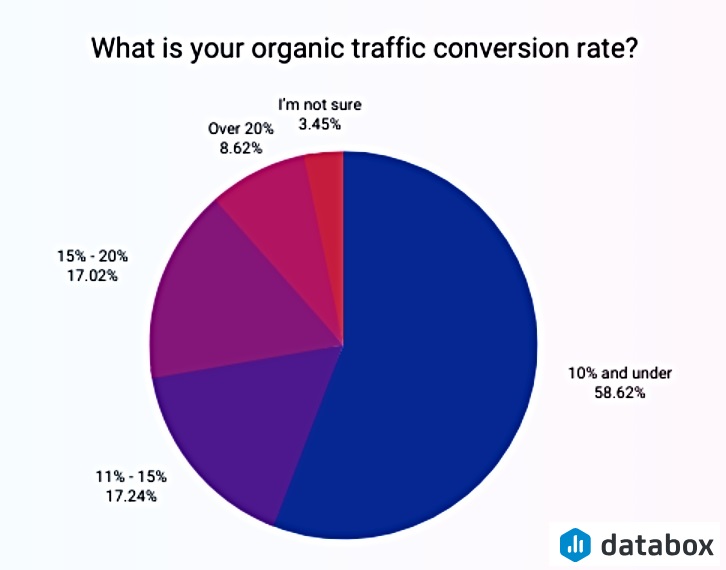
Many said that numbers between 2% and 5% are satisfying, while some responded that they aim for 20% and above. The vast majority of participants (just shy of 60%) shared that their average organic traffic conversion rate is around 10%.
Paid Traffic Conversion Rate
Managing paid campaigns for various businesses and organizations, we closely monitor our figures.
Ernst Media's average conversion rate for paid search ads is between 4% and 5%. For some clients, we often achieve north of 10%. Display ads are usually below 1%, which is the case across the board.
As for Social Media, we maintain 7-8% on average with Facebook and around half of that with paid ads on the other platforms.
Is Organic or Paid Traffic Better for Your Business?
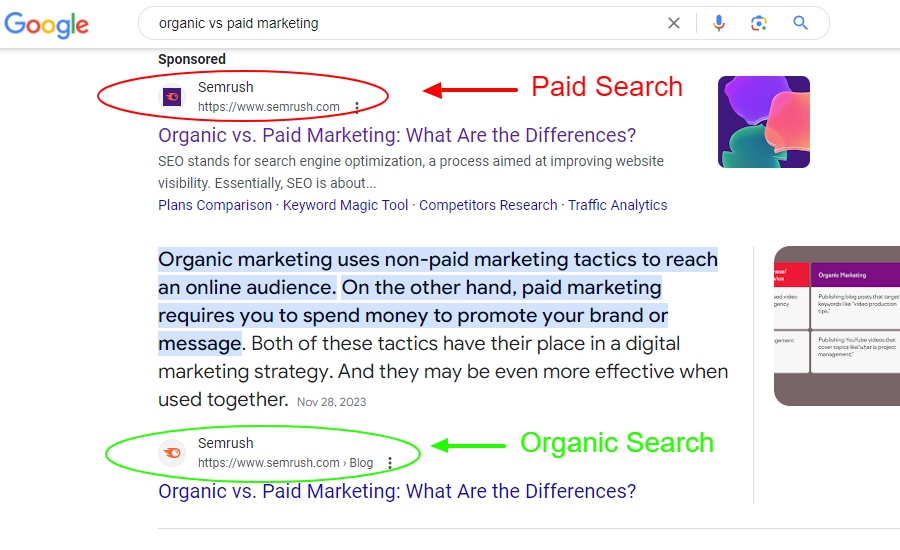
As we discussed, both organic and paid traffic have merits. To dominate search results, you have to use SEO and PPC advertising in tandem. Semrush's work on the search term "Organic vs. Paid Marketing" is a perfect example.
I understand that not everyone has the resources to do that. Here are more numbers to help you decide which approach best aligns with your current business goals.
On average, the company blogs we provide SEO services for see 50% more traffic after 6 to 8 months. One reason is that organic search results get 10x more clicks than ads.
Of course, most of these clicks will not result in revenue immediately, but they will move visitors to the next stage of your digital marketing funnel...And build credibility.
While just 15% of website traffic comes from paid search, you shouldn't underestimate the power of driving immediate results. Paid digital marketing channels instantly put your brand in front of folks looking for what you have to offer.
With proper optimization, you can get a 4-5x return on ad spend in a month. Here is a guide on how to increase the ROI of PPC campaigns.
Do you need help with digital marketing?


Founder of Ernst Media. Fifteen years running paid search and paid social for small and mid-size businesses, and still the person who builds the audits by hand. Writes here about what actually moves accounts.