
Nobody can tell you what Google Ads will cost your business without your numbers. Not because it is a secret, but because the cost is an output, not a price tag.
Two things add up to it.
Ad spend. What you pay Google when someone clicks. You set this figure, and it should come out of a revenue goal rather than out of somebody's published average.
Management. What you pay a person to build the account, watch it, and cut what is not working. For our PPC management that is $95 an hour, month to month, with no contract and no percentage of your spend.
The rest of this post is how to work out the first number, what moves it up and down, and the point below which I tell people to keep their money.
My name is Evan Ernst. I founded Ernst Media in Spokane in 2026. There are seven of us, and running paid search for small and mid-sized businesses is most of what we do.
Why Business Size Doesn't Set the Price
The question I get on nearly every first call is some version of "what do companies like mine spend?" It is the wrong question, and answering it has sent more small businesses down the wrong road than almost anything else in this industry.
A large company might put a small slice of its marketing money into search and spread the rest across a dozen channels. A small business with one good channel and no marketing department often puts far more into search than that large company does, because it is the only place the money goes. Size tells you nothing. The goal does.
So skip the averages. Work out your own number instead.
What Actually Sets Your Cost Per Click
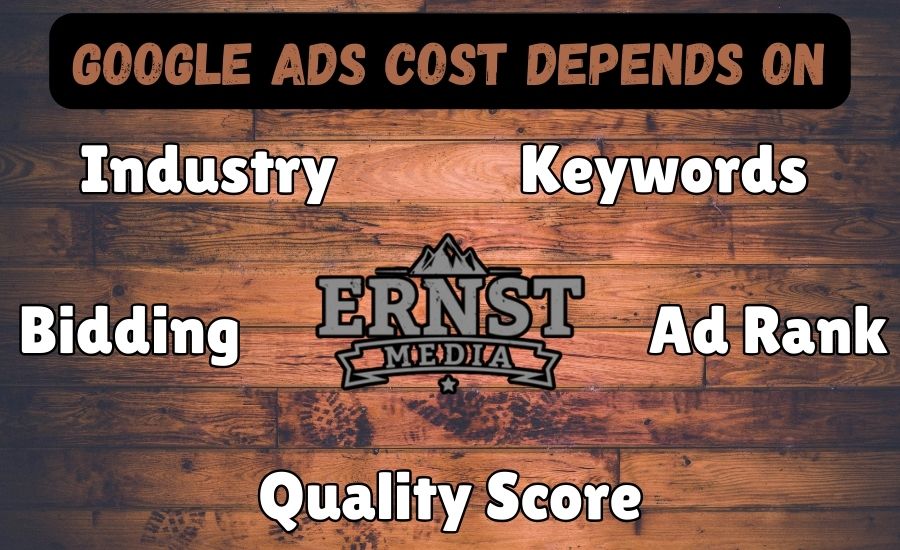
There is no list price. Every search runs an auction, and your cost per click falls out of it. Five things move that number.
Your industry
Cost per click tracks competition. If you sell something with a high value per customer and a crowded field of advertisers, clicks are expensive. A local service with three competitors in town is cheap by comparison. Across the accounts we run, the same click can cost several times more in one industry than another, and the same is true of digital marketing more broadly.
Your keywords
Popular phrases cost more, for the same reason popular anything costs more. The useful move for a small budget is to find the near-synonym that fewer advertisers have thought of. The same searcher, the same intent, a fraction of the price. That is most of the craft in PPC advertising.
Your bid
You decide what a click is worth to you. The auction takes that number as an input, not as a verdict. Bidding more is the least interesting way to win.
Your quality score
Google scores how relevant your ad and landing page are to the search. A good score buys you a better position at a lower price. As we cover in our Google Ads strategy tips, this is where a small advertiser can beat a bigger one, because relevance is not something you can outspend.
Your ad rank
Bid and quality score combine into ad rank, and ad rank decides who shows and where, below Google's Local Services Ads where those run.
The practical consequence: when a client's costs are too high, we almost never raise the bid. We fix the ads, the keywords, and the landing page, so the same money buys a better position. That is why the businesses we work with stay.
How to Work Out Your Own Google Ads Budget
Start at the end. Decide what you want the ads to produce, then work backwards to what that costs.
Say your business does $12,000 a month and you want to add half again, so $6,000 in new revenue.
- If your average sale is $200, that is 30 more sales.
- If 5 in 100 visitors buy, 30 sales needs 600 clicks.
- If clicks on the terms you want run $2, 600 clicks is $1,200 a month.
Every one of those five numbers has to be yours. The revenue goal comes from you. The average sale comes from your books. The conversion rate comes from your analytics, or from an honest guess you correct after the first month of real data. The cost per click comes from Keyword Planner, for the exact phrases you would bid on, in the towns you actually serve, not from a national figure in an article.
Run the arithmetic with your own inputs and you get a spend figure you can defend. It also tells you something more useful than the number itself: which lever is cheapest to pull. If the conversion rate is the weak link, fixing the landing page costs less than buying more clicks. Google's own explanation of how return on investment works is worth ten minutes before you set a budget.
What the Management Side Costs
Plenty of agencies charge a percentage of your ad spend. Think about what that pays them to recommend. Every extra dollar you put into Google raises their invoice, whether or not it earned anything. Performance fees have their own version of the problem, since they reward whichever metric got written into the contract.
We charge $95 an hour, flat. If you double your budget, our work does not double, so our fee does not either. There is no setup fee and no package. You can stop at the end of any month.
I am not going to publish a monthly figure for what an account takes, because it depends on how many campaigns you run, how many products or services you sell, how much of the account already exists, and how fast things change in your market. What I will tell you is that we scope it with you before you sign anything, and you see the hours.
The Floor: $500 a Month in Ad Spend
Our minimum is $500 a month, and it is not an arbitrary sales threshold. Below that, an account cannot gather enough clicks to tell signal from noise, so nobody can optimize it, and the time it takes to manage properly costs more than the ads return. Paying someone $95 an hour to tend $300 of spend is a bad trade for you.
If the arithmetic above lands you under $500, paid search is not where you start. Put the money into the things that work at a small scale first: your Google Business Profile, the pages people already land on, and the organic side, which is slower but compounds. Come back to ads when the budget can support them.
There are a few other cases where I tell people not to bother, mostly around demand that does not exist yet and phones nobody answers. They are laid out in full in Google Ads for small business.
What Return Is Reasonable to Expect
You will find people online quoting eye-watering return multiples. Some of them are real and almost none of them are typical, so treat the number as marketing rather than as a forecast.
We aim for a return of several times spend, measured in the thing you actually sell rather than in clicks. Two published examples: Silvertrac hit a 4× return on ad spend in the first month after we cut the waste out of an inherited account, and KDRO Consulting went from a $1,000 cost per lead to under $100. Neither is a promise about your account. Both show what the ceiling looks like when the offer is right and the tracking is honest.
The first month is usually about buying data rather than profit. Then you use it to grow the account, and the cost per sale comes down as the waste comes out.
The Short Version
Your Google Ads cost is spend plus management. Spend comes from your own goal, average sale, conversion rate, and the real cost per click on your terms. Management, with us, is $95 an hour, month to month, with no cut of your budget. And if the number comes out below $500 a month, we will tell you to wait rather than take the work.
Want us to run those numbers with you? We do it on the first call, before anyone signs anything.


Founder of Ernst Media. Fifteen years running paid search and paid social for small and mid-size businesses, and still the person who builds the audits by hand. Writes here about what actually moves accounts.