
Search engine optimization is a very broad digital marketing strategy with so many moving pieces. No matter what SEO consultant or agency you speak to, they'll tell you the same:
It all starts with keyword research.
That holds whether you're going after paid or organic traffic. This post is about the organic side.
Today, I'll be going over the different types of SEO keywords we use at Ernst Media, why the research matters, and the process we follow to turn it into a strategy. And at the end of this post, you'll have a grasp of what they are, and how to use them properly.
Let's get into it!
What is an SEO Keyword?
A keyword is a word or phrase used to find information on the Internet through search queries. It's pulled up through crawlers pushed by search engines like Google and Bing.
They decide whether a user's search query relates to a website's content and if that piece of content should be in the top search results.
To help them make a decision in your favor, you need to include a selection of SEO keywords.
The keywords you choose have a direct impact on how your content will rank on search engine results pages. That's exactly why keyword research is so important for a successful SEO strategy.
Why Keyword Research Is Important
Kept simple, keyword research matters because:
- Your target audience is asking questions.
- You need to answer their search queries.
The days when you could write a few articles about your products and services and show up in the results are long gone. Today you have to publish enough content to build topical authority. Not being recognized by Google as an expert in your industry is often why SEO isn't working.
The research also tells you what your potential customers actually type into a search engine when they're looking for help, and what your competitors already rank for, so you can decide whether you can take some of that traffic. What you're after is keywords with decent search volume and low difficulty that you can build educational content around.
What Are the Types of SEO Keywords?
Marketers have different opinions on how many types of keywords are used in SEO. I've been a Digital Strategist at Ernst Media for many years, and we always break them down to 9:
Short-tail, long-tail, product-defining, customer-defining, branded, long-term evergreen, LSI, geo-targeting, and the most important keywords targeting specific search intent.
I say the most important because these types of keywords will bring the most SEO benefits to your business.
It's plenty, I know. But don't worry. I'll cover each one so you can choose the right SEO keywords to increase your website's organic traffic. Or, if you consider delegating this task to an SEO agency, you'll have a better understanding of their processes.
Short-Tail Keywords
Short-tail keywords, also known as seed or generic keywords, are the most common. People type those to find information quickly, usually for a specific product or service. We use them mainly when creating a primary keyword. A primary keyword is a page's main topic, like "Men's Shorts" or "BMW Wheels."
Such short generic keywords have huge search volume, but don't be tempted. Ranking for any of these is close to impossible with a blog post unless you have the domain rating of "Forbes."
Long-Tail Keywords
Long-tail keywords are more specific and less popular than short-tails. They usually consist of at least three to four words and are great for both e-commerce and service business SEO.
- They give you more options to include related keywords in a page or blog post.
- They trigger queries/questions that you can answer and drive organic search traffic.
- They are very important for any SEO keyword strategy and shouldn't be overlooked.
Product-Defining Keywords
Product keywords help customers find your website when they describe what they want to buy. Thus, we focus on these when doing SEO work for e-commerce sites looking to attract a target audience.
Customer-Defining Keywords
Customer-defining keywords and product-defining keywords can be easily confused, so let me tell you what the difference is.
Product keywords describe a product or service in detail, while customer-defining keywords describe the customer's needs and wants.
They're both great for your SEO strategy, but it's good to know the difference when writing a page or blog post with a specific search intent.
Branded Keywords
People use these types of keywords when they want information about a particular company. That said, we implement branded SEO keywords in a marketing strategy on two occasions:
When we work with a well-established brand or when we run organic search and brand awareness social media campaigns for a client at the same time.
Long-Term Evergreen Keywords
These have a high search volume over a long period of time, making them the best SEO keywords for content websites like food and how-to blogs.
Recipes for “garlic parmesan grilled chicken” have a specific search volume that will rarely waver upward or decrease. The same applies to queries like "How to change a flat tire."
It doesn't have much societal swing, nor is there anything that happens in the news that could sway people to search for such keywords. Once you get high search rankings for those, all you have to do is update the content every six months or so to keep a steady incoming traffic flow.
LSI Keywords
Latent semantic indexing (LSI keywords) have similar meanings to the seed keyword but different contexts. So, if we had a short-tail keyword like “phone,” we could use other words like “cell phone,” “Samsung phone,” “Android phone,” etc.
It may not relate directly to the subject, but it has the same keyword intent, and that's the point. It can be a huge game changer for triggering more search queries, and if used correctly, you'll still be reaching the same target audience.
Geo-Targeting Keywords
These keywords are the main ingredient of local SEO. Using geo-targeted keywords along with tools like Google My Business and Bright Local is the way to get your services at the top search results for your city. I mean, there is another way, but that's part of a Google ads strategy.
Intent Targeting Keywords
The final SEO keyword comes into play when crafting your content based on what people want to do with it. Do they want to buy something or learn more about it?
These types of keywords can be so broad that I have to go more in-depth. The different intentions that people have when they search for information actually give us another four keyword categories.
Pay close attention to those! As Brian Dean says in his article:
"Google’s most recent edition of its Quality Rater Guidelines is obsessed with Search Intent. While backlinks and other traditional ranking signals still matter, if your page doesn’t satisfy Search Intent, it won’t rank."
Informational Keywords
These are long-tail keywords or phrases that people use to find information about a subject or learn how to do something. Building topical authority in your industry is the key to organic traffic nowadays, and writing educational blog content is how you show search engines your expertise.
Navigational Keywords
These are words or phrases that people use in search engines to land on a particular page of a website. For example, if you're looking for a "Red Lacoste winter sweater for men," you'll type that in the Google search bar instead of going to the Lacoste website, its product pages, applying filters, etc.
Most of the time, we use navigational keywords in SEO to enhance product page titles and descriptions and for internal links.
Commercial Keywords
These are words or phrases that people use to find products and services without looking for a particular brand. Like the sweater example above, but without the "Lacoste."
People usually think about spending some money, but that's not always the case. So, if you're going to use commercial keywords, check the top search results to make sure you match the user intent.
Transactional Keywords
When typing transactional keywords in the search bar, people are ready to buy. However, often they haven't decided on a brand, model, material, etc. yet.
They won't search for "Nike men's running shoes" but rather go for "Best running shoes for men."
We've noticed that queries starting with "top" or "best" have become quite popular over the last couple of years. While these are utilized mainly by affiliate marketers, if you run an e-commerce business with a large inventory, you can also write "Best of" types of posts.
How We Turn Keywords Into a Strategy
Most of the small businesses we work with already have a brand and a website. Even if you haven't published a word yet, the steps are the same. Plenty of companies never look at the keywords they're already ranking for, so that's where we start.
Start in Google Search Console
The first pass looks at the keywords the site ranks for today and the position of each one. That tells us where the time and effort should go. Google Search Console is free, and the data in it is enough to assign a value to every keyword.
Some keywords are competitive because everyone shopping for that product or service uses them, so ranking means reworking the existing articles and writing new ones. Others are more obscure and get less search volume, which usually means lower difficulty and fewer sites competing for the same spot, so the first page is within reach. We then validate the shortlist against the analytics data for those pages.
Use the Keyword Research Tools
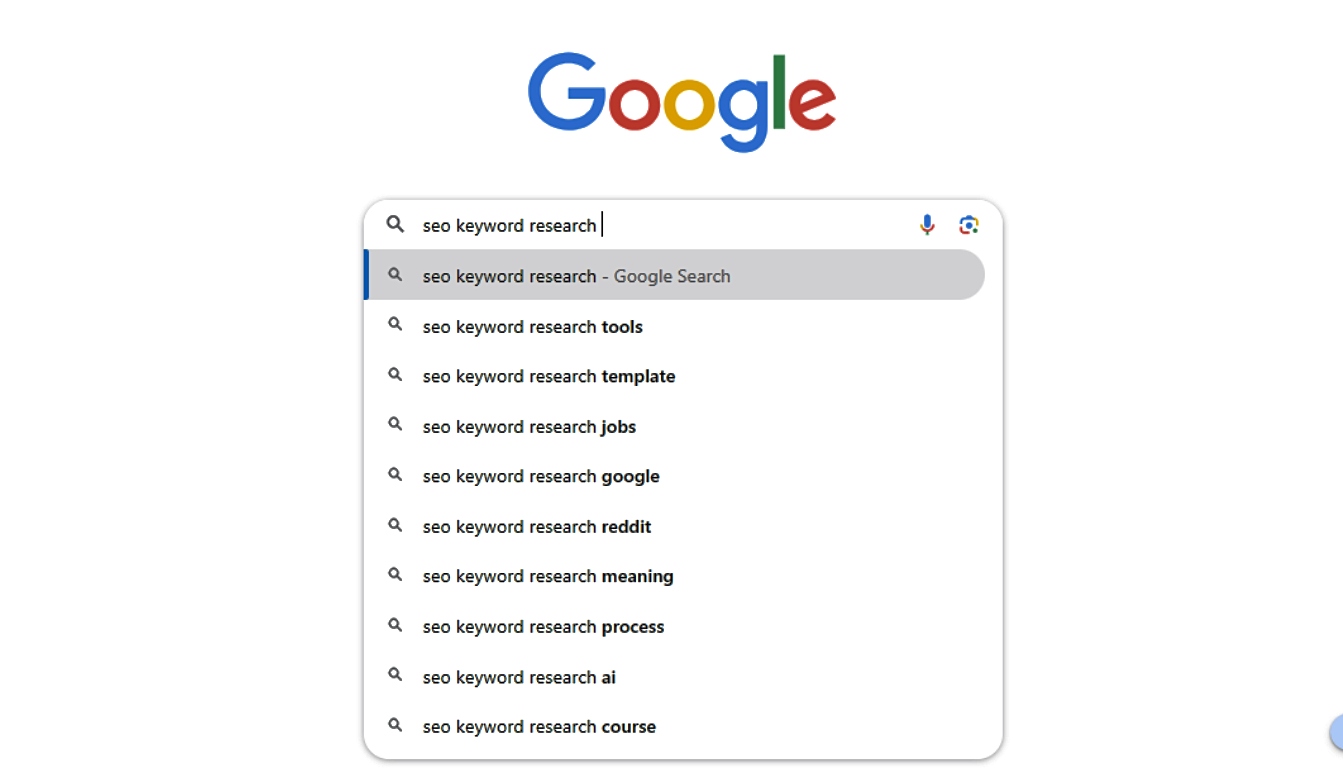
Next we pull ideas out of tools like Semrush and Ahrefs. Without a budget for those, Google Keyword Planner and Google Trends are free, and even typing your keyword into the Google search bar will hand you content ideas in the autocomplete.
We use the tools to find the hidden gems: search terms with real demand that nobody has covered well. Content built around those lifts the rankings you already have and adds to the site's topical authority.
Keyword research counts just as much for paid search, with one difference. For PPC we go after transactional keywords. For organic we aim at informational ones, because people ask Google questions before they decide what to buy. Those questions usually run three or four words or longer, and long-tail keywords are easier to rank for even though fewer people search them. Non-branded keywords like these are also what SEO branding strategies are built on.
Read the Search Results
Once we know what the site ranks for and have a list of new ideas, we search every phrase in Google and read the results to decode the intent behind it.
Matching that intent is the biggest factor in whether a keyword strategy works. Say you sell shoes and you turn up the long-tail keyword "How to Choose Running Shoes." It has enough search volume to be worth a post, and it can be the exact title. But the people typing it want to know how to pick a pair, so they expect an explainer. If your article is a list of ten models you happen to stock, you haven't matched the intent, and Google won't send you the traffic.
The plan we end up with comes down to two numbers:
- How many keywords rank in positions 1 through 10.
- How many keywords the site ranks for in total.
We move both by going after high-value, less competitive keywords rather than the ones with the biggest volume.
Conclusion
As you can see, there is a wide range of keywords in SEO to play with. I hope you have a better understanding of the different types and how to pick the right target keywords.
Figuring out the search intent is the key. If you don't get it right, your SEO won't work. Even the best content can get buried on page 10 of Google's search results.
If you want to find out how the keywords in your site are being used and whether or not you're sending out the right intention, come connect with us at Ernst Media.
Let's get an audit together to get you pivoted in the right direction with your target audience!

Co-founder. Runs every first conversation himself, then stays on the account.