
If you only have the budget to run one paid channel properly, run paid search.
People searching for what you sell have already decided they want it. That is the shortest distance between money spent and a lead in your inbox, and it is where most of our small business clients see their lowest cost per lead.
Paid social comes second. It buys attention instead of intent, so the creative has to do the work the search query does on Google. It reaches people who would never think to look you up.
Influencer partnerships come third, and for lead generation they come a distant third. They build trust. They rarely fill a calendar this quarter.
That is the short answer. Hi, my name is Evan Ernst. I run a seven-person agency in Spokane that has been buying media for small businesses since 2026, and below is the longer answer: what each channel is actually good at, what it costs you in effort, and when I would tell you to skip it.
What Are Paid Digital Marketing Channels?
Paid digital marketing channels let you buy attention from a specific group of people instead of waiting to earn it. You pay per click, per thousand impressions, per lead, or per view. The alternative is owned media — your blog, your newsletter, your videos — which costs time instead of money and works on a much longer clock. Both matter, and I've written about how they fit together.
The paid channels worth a small business's money fall into three groups: search engines, social platforms, and paid partnerships with creators. The usual starting point is Google Ads, which by itself offers several ways to promote your business — text, display, local and video.
One thing before we get into it. Our floor is $500/month in ad spend, and that is not an arbitrary number. Below it, no channel gets enough data to learn from, and you spend more time reading noise than making decisions. If your total budget is under that, put it into SEO and an email list instead and come back to this article later.
Paid Search Marketing
Paid search puts your ad on the results page when somebody searches for what you sell. Of the three channels here, it is the one most likely to produce a lead in the first month, because you are buying demand that already exists rather than creating it.
It is also most of what we do at Ernst Media. Mainly text search and shopping ads, mainly for small businesses, and it is where most of our testimonials come from.
Both formats are pay-per-click based (PPC advertising). Here is how each one behaves.
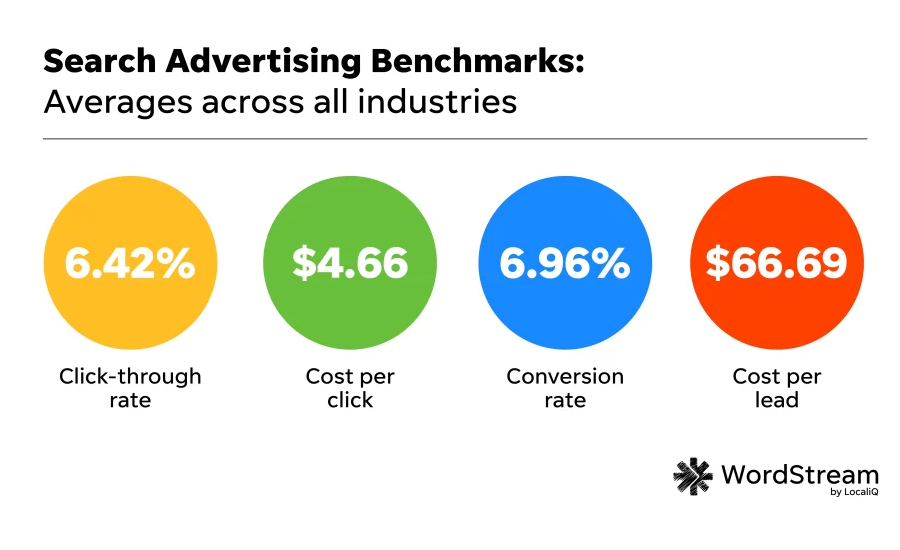
The chart below comes from WordStream's 2026 benchmark report. Read it as a rough map, not a target. Cross-industry averages hide more than they show, and your own account will tell you the truth within a few weeks of spend.
Text Search Ads
These are the most common paid search ads, and they work for both B2C and B2B. They sit at the top or bottom of the results page: a headline, a display URL, a short description.
They earn their money when the messaging is specific and when you have the Ad Rank to land above the organic results. Below that line you are paying for the scroll.
Once an account has enough history behind it, we add image assets alongside the text. When every competitor in the auction is running text only, an ad carrying an image takes up more of the screen and gets noticed. It is one of the cheapest edges left in a mature auction.
Shopping Ads
Shopping ads put the product itself in the results: image, price, merchant name. They are the backbone of eCommerce PPC, because somebody comparing prices is already close to buying.
With well-structured Shopping campaigns we have brought the cost per click down for a lot of small retailers on our PPC management service.
Retail search budgets have shifted heavily toward Shopping, and that is exactly why I think there is room to go the other way. When most of the money in your category is chasing product listings, a well-written text ad that answers a question a listing cannot answer is often cheaper and converts better.
One Word on Performance Max
Google will steer you toward Performance Max, which spends across search, shopping, display, YouTube and Gmail from a single campaign. It can work well. It also blurs where the money went, and that is a bad trade when you are spending small and need to learn quickly.
We start narrow — search and shopping, where we can still see the query that triggered the ad — and widen only once there is a working campaign to widen from.
If you want leads from paid search but can't decide where to start, I'm here to help.

Social Media Advertising
Every major platform sells ads. Facebook, Instagram, LinkedIn, YouTube, X, Pinterest and Reddit all take your money and all target differently.
The trade with paid social is simple to state and hard to accept. Nobody on these platforms asked to see your ad. The creative has to do the job the search query does on Google, which means weak creative on paid social doesn't underperform, it does nothing at all.
I'll focus on Facebook, YouTube and LinkedIn. In my experience those are the best social media platforms for small businesses.
Facebook Ads
Facebook still reaches the broadest audience of anything we buy, and its measurement is the most forgiving for a business running ads without a specialist on staff. It is where most of our paid social lead generation happens.
Two things have changed in a way that affects your budget. Ad prices climb as more advertisers bid for the same attention, so the CPM you paid two years ago is not the one you will pay now — watch your cost per lead, not your cost per thousand. And Meta's automated campaign types now do most of the targeting work, which means your real inputs are the creative, the offer, and whether your conversion tracking is honest. Audience checkboxes matter far less than they used to.
Based on that and the results we deliver for clients, Facebook ads are worth it for most small businesses. The exception is a high-ticket B2B offer aimed at a narrow buyer. There the waste rate gets ugly fast, and LinkedIn is the better bet.
YouTube Ads
YouTube is the second place people search, not only the second place they watch. Somebody looking up how to fix a thing, choose a thing, or compare two things is a warm audience, and that is what makes the platform useful to a small business.
The format situation has settled since I first wrote this. Video Action Campaigns are gone; Google folded them into Demand Gen, which now runs video, image and short-form placements across YouTube, Discover and Gmail from one campaign. If you ran YouTube ads before that migration and haven't looked since, your campaign was moved across, not tuned.
YouTube earns its budget when you have something to show — a process, a before and after, a person worth trusting. It is a poor fit when your strongest asset is a price list. And if you assume the platform skews older or younger than your customers, check your own analytics before you rule it out. That assumption is wrong more often than it's right.
There's more in my article on the advantages of YouTube advertising for small businesses.
LinkedIn Ads
LinkedIn is the one channel here where the audience is defined by job, company and seniority rather than by interest. If you sell to executives, to procurement, or to one specific job title, nothing else targets that as cleanly. I've gone deeper on this in do LinkedIn ads work.
It is also the most expensive click we buy anywhere, by a wide margin. That is fine when one closed deal is worth five figures to you. It is not fine for most B2C, where the click price eats the margin before the lead ever arrives.
Not saying it isn't worth trying. If you know your buyer well and you have run campaigns before, you may do well. As Shaun of the B2B House puts it in his deep dive on LinkedIn ad costs:
"Linkedin rewards advertisers for meeting their member's needs with lower ad costs"
You are probably wondering whether organic social still does anything. It does, but slowly. We build brand awareness organically through our small business social media services, and the combination is what works — organic gives your paid ads a profile worth clicking through to.
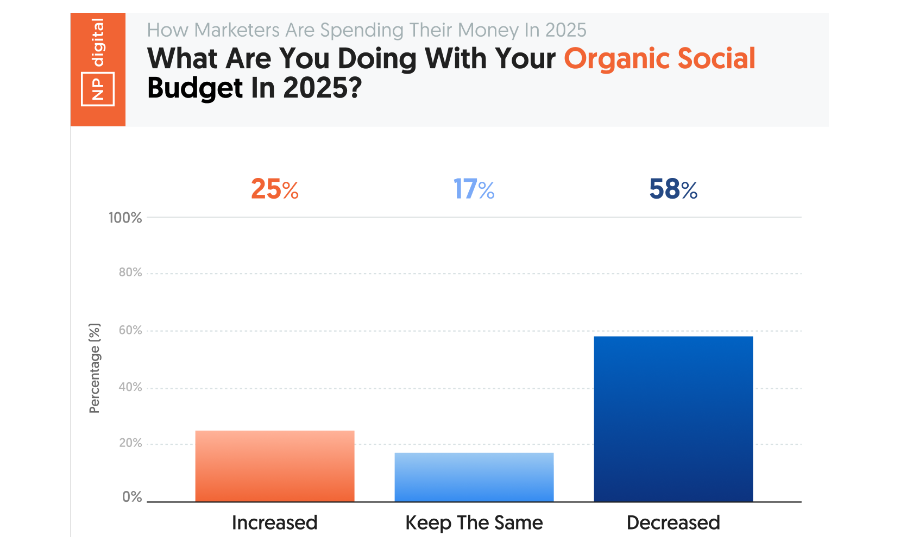
The direction of the money has been clear for a while. The chart below is how marketers said they would split organic and paid social going into 2026, and most were cutting the organic side. I read that less as "organic is dead" and more as "organic stopped being free."
Influencer Marketing
Influencer partnerships are the third channel, and I want to be plain about what they are for. They build trust and borrow an audience that already trusts somebody else. They are not a lead generation channel in the way the first two are. If your goal this quarter is a full calendar, that money belongs in search.
Where they earn their place is when you are new, unknown, or selling something people need to see used.
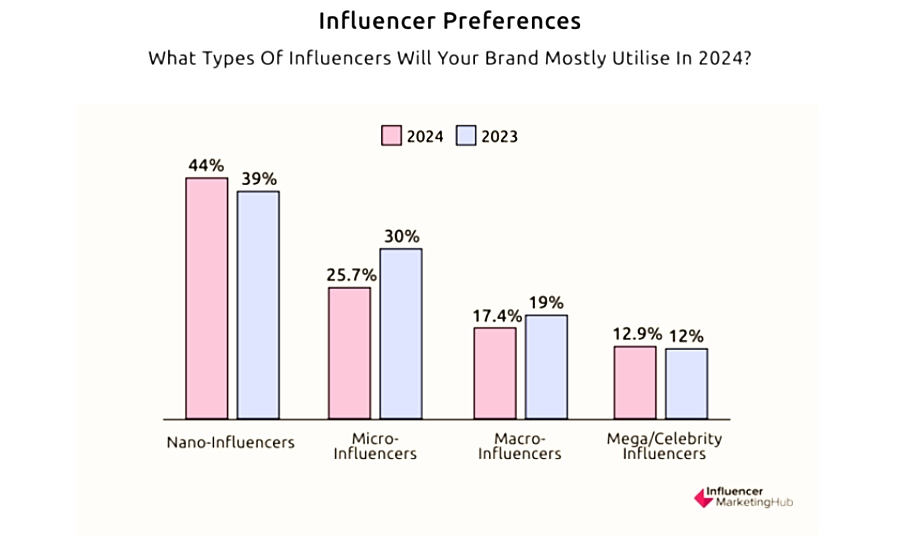
You are not looking for Kim Kardashian. You are looking for micro and nano influencers — creators with a few thousand engaged followers inside your niche. They cost far less, and the connection with their audience is real, which is the entire point. Follower count is the least useful number on the page. Engagement rate is the one to ask for.
Most businesses worked this out a while ago. The chart below, from Influencer Marketing Hub, shows how strongly the preference already ran toward the smallest creators back in 2026.
Insist on two things before you pay anyone. A trackable link or discount code, so the partnership shows up in your analytics instead of in a feeling. And usage rights on the content, so you can run the posts that performed as paid ads afterwards. That second one is often where most of the value ends up.
The Bottom Line
If you need leads and you need them soon, start with paid search. It is the only one of the three where somebody is already looking for you.
Add paid social once search is working and you want more volume than the search demand in your market can supply. Facebook for reach, YouTube when you have something worth showing, LinkedIn when a single deal is worth a lot and your buyer has a job title.
Treat influencers as a trust and awareness spend, and hold them to a trackable link like any other channel.
And if none of this is the right time — if you're under $500/month in ad spend, or your website can't convert the traffic you'd send it — then SEO and an email list will do more for you than any of it. Those take longer to build momentum, but they compound.
My team and I at Ernst Media can help you pick, whether that means assisting your in-house team or running the whole thing. We work month to month, no contracts, at $95/hour, and we'll tell you if paid media isn't your problem.


Founder of Ernst Media. Fifteen years running paid search and paid social for small and mid-size businesses, and still the person who builds the audits by hand. Writes here about what actually moves accounts.