
Most of the accounts I audit are not losing money because someone picked the wrong bid strategy. They are losing money because nobody decided what the campaign was for, and the tracking underneath it was counting the wrong thing.
This is the process we work through, in order. Goals, tracking, audience, platforms, structure, keywords, ad copy, landing pages, then bidding and the weekly numbers. It is written so you can run it yourself.
If you would rather hand the account to someone else, that is what our PPC management service is for. One honest caveat first: under about $500 a month in ad spend, paying anyone to manage a campaign costs more than the campaign returns. That is our own minimum, and at that budget you are better off working through this guide yourself.
New to paid search? I answer the most common questions in this post before you spend anything.
What has changed, and what hasn't
The bid is no longer the job. Google and Microsoft both set bids by machine on most campaigns now, and the manual levers that filled guides like this one a few years ago have either gone or stopped mattering much.
What you still control has not changed at all:
- What counts as a conversion, and whether it is measured correctly
- How the account is structured, and what each campaign is allowed to spend
- Which searches you refuse to pay for
- The ad copy and the page it lands on
Every section below sits in one of those four buckets. When something in the platform moves, the bucket stays put.
The PPC campaign management process
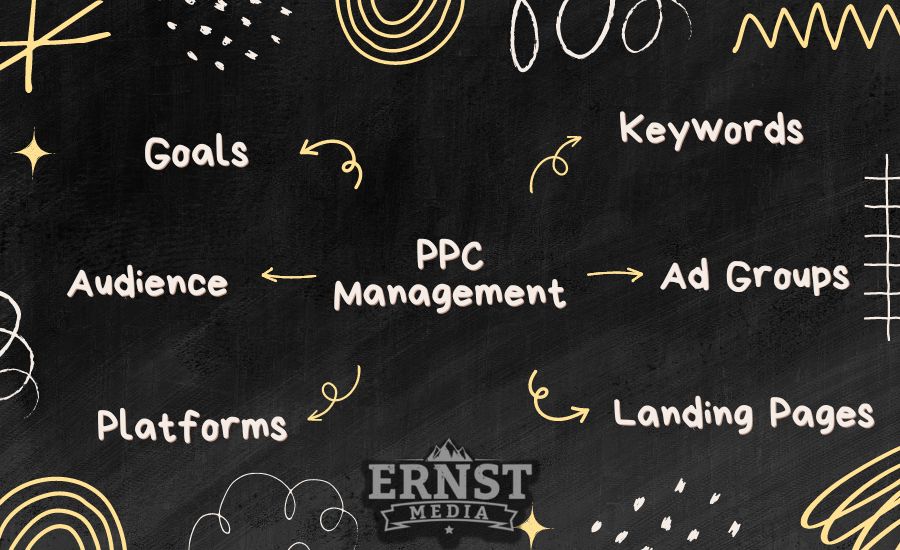
Defining your campaign goals
Align the goal with measurable demand for your product or service, not with a number someone picked in a meeting.
- Look at search volume trends for related keywords
- Check your website traffic and engagement levels
- Analyze sales data to pinpoint demand peaks and valleys
If demand is not there, no amount of campaign management manufactures it. That is worth knowing in week one rather than month four.
Getting conversion tracking right first
This step was buried near the end of the earlier version of this guide. It belongs at the front now, because automated bidding optimizes toward whatever you tell it a conversion is. Tell it the wrong thing and it will get very good at buying the wrong thing.
Before you spend a dollar:
- Decide which single action is worth money to the business. A submitted form, a booked call, a purchase. Not a page view, not a scroll.
- Set the tags and events up so that action fires once and only once.
- Add call tracking if the phone is how customers actually reach you.
- Push offline outcomes back in if the sale closes days later, so the machine learns which leads were real.
Most accounts we take over are counting something softer than a sale, which is why the reported conversion numbers look fine while the bank account does not.
Knowing your audience
Understanding your target audience is your roadmap. Identify your customers' touch points and learn about their demographics, income, interests, and where they already spend time.
Your own analytics and the ad platform's audience reporting will tell you who is already interacting with your brand. Your sales team will tell you the rest, and usually faster.
Then write the ads for those people rather than for the industry.
Selecting the right platforms
Google is where most buying intent still lives. If you are already running there, here are some tips on how to boost your strategy.
For clients in competitive industries who cannot win a bidding war with a national brand, we often pivot to Microsoft Advertising. Less competition, cheaper clicks, and a different set of searchers.
Beyond search, pick from where your customers already are, not from a list of what is popular. Most businesses need one search channel plus one other, not six. We combine paid search traffic with a single social platform far more often than we run a full spread, and the accounts that try to run everywhere at once are usually the ones spending too little on each to learn anything.
Structuring campaigns and ad groups
A well-structured ad group helps you match search intent, and it gives you somewhere to point the budget when one theme starts working.
I explain ad groups to clients as individual stalls in a marketplace. Each stall is organized around one theme or product category.
If you sell athletic footwear, one ad group might cover women's running shoes and nothing else. Keywords like "women's running shoes," "best running shoes for women," and "women's trail running shoes" belong together because one ad can honestly answer all three.
The ads in that group then talk about cushioning, fit, and design for that shoe. Relevance goes up, Quality Score goes up, and you can read the results without untangling four products from one line of data.
The other half of structure is budget. Each campaign is a separate wallet. Splitting a theme into its own campaign is how you protect its spend from a louder, less profitable one.
Conducting keyword research
We start by analyzing competitors' keywords, which is the fastest way to see what a market is already paying for. Then we look for long tails and variations, hunting for decent volume that is not yet expensive.
Google's Keyword Planner is free and good enough to begin with.
One caution that matters more than it used to: match types are looser than the names suggest, and a phrase or broad keyword will pull in searches you did not picture. Plan the keyword list, but expect the search terms report to be where the real list comes from.
Implementing negative keywords
Exclusions are now the main steering wheel you still hold, which makes weekly negative keyword work one of the few habits that changes a paid search account. Read the search terms report every week and cut what does not belong. That does two things:
- Keeps your ads in front of the right audience
- Stops the bidding algorithm from learning off junk traffic
We had a client renting out boats. Three negatives did most of the work:
- "Boat sales" for people wanting to buy rather than rent
- "Repair" for people looking for a mechanic
- "Lessons" because the business did not teach
None of those are clever. They are just the result of someone reading the report.
Writing ad copy that earns the click
Each ad should demonstrate a unique value proposition. If it is not persuasive, nobody clicks, and every step above was wasted.
I have met salespeople who think writing ads is a no-brainer. They miss one thing: our words here are severely limited.
Paint the picture with fewer words. Good ad copy:
- Presents a compelling offer
- Includes the keyword the person searched
- Connects with the problem behind the search
- Ends with a short, specific call to action
Modern search ads assemble headlines and descriptions on the fly, so write every headline as though it might appear next to any description you wrote. Vague filler survives that process. Specific claims do not, which is a good reason to be specific.
Designing landing pages
The landing page should carry the ad's promise straight through. As I explain in the PPC for eCommerce guide, it should lead people to one action with nothing in the way.
Here is the failure I see most:
Someone clicks an ad for a specific pair of shoes. They land on a category page with twenty models and a newsletter pop-up. They leave, and you paid for that.
The page should show the advertised thing immediately.
After that, make it convert. Responsive design, real social proof, and regular split testing on headlines, images, and calls to action.
How to optimize PPC campaigns
Automated bidding is the default now
Depending on the objective, you can ask the platform to maximize clicks, maximize conversions, or hit a target CPA or ROAS. That choice is now most of the bidding decision.
Automation is not the risk. Automation pointed at bad data is the risk.
Start with a broad objective while the account is thin, and only move to a target CPA or ROAS once real conversions are coming through consistently. Setting an aggressive target on day one usually means the campaign throttles itself down to almost no traffic and never gathers the data it needed.
When manual bidding still helps
Manual bidding has gone from the main tool to a narrow one. It is still useful for two things: starting a brand-new campaign with too little conversion history for automation to learn from, and diagnosing a specific keyword when you want to see what a click really costs without the algorithm in the middle.
It is not a way to beat automated bidding at scale. If your instinct is to hold onto manual control because the automated strategies have burned you before, the fix is almost always the conversion tracking, not the bid.
Either way, someone has to read the account regularly. That is why plenty of businesses hand it to a team that does PPC management full time rather than fitting it around a day job.
Give changes time to settle
The old version of this guide told you to tweak bids daily until you found the sweet spot. That advice is now actively harmful. Significant changes restart the learning the bidding algorithm has done, and an account edited every morning never gets past that stage.
Batch your changes. Make them, then leave them alone long enough to read a result. The exception is anything that is clearly wasting money right now, like a search term you never wanted to pay for. Cut those the day you see them.
The platforms will tell you to wait two weeks between changes. That is roughly right, and it took me longer than I would like to admit to stop arguing with it. Ernst Media has been running accounts since 2026, and the accounts we touch least often between reviews are usually the healthy ones.
Performance Max and the other black boxes
Campaign types that bundle search, shopping, display, and video into one automated unit now take a large share of spend, and they hide more than a search campaign does.
The principles still apply, they just move:
- Asset groups play the role ad groups used to. Keep each one to a single theme.
- Feed quality and conversion tracking drive the outcome, so fix both before you turn the campaign on.
- Use every exclusion the campaign type gives you. That is your remaining steering wheel.
- Check what the campaign spent against your existing search campaigns, so the two are not buying the same customer twice.
If you cannot see where the money went, treat that as a reason to keep a conventional search campaign running alongside, not as a reason to trust the automation harder.
Allocating budget across campaigns
Allocating budget across campaigns is like rebalancing an investment portfolio.
Move money toward what is already converting, and take it away from what is not.
Do that from the data rather than from the campaign you feel most attached to. Our SEM audit guide walks through the analysis in detail. Sometimes the answer is that total spend should come down, which is a legitimate outcome and one worth saying out loud.
Monitoring and refining performance
At some point the campaign will feel finished. Keep reading it anyway. A full SEM audit, or a lighter account evaluation, is how you find the next thing.
Tracking the numbers that matter
These are the metrics that carry the most signal:
- Click-through rate. A high CTR says the ad matches the search. A low one points at the copy or the targeting.
- Cost per click. Compare it across campaigns and ad groups to find where costs can come down without losing volume.
- Conversion rate. A low rate usually means the landing page is not delivering what the ad promised.
- Cost per conversion. The number to judge a campaign by when revenue per sale is roughly constant.
- Return on ad spend. The number to judge it by when it is not.
- Impression share. Low share means budget or ad quality is capping your visibility, and it tells you whether there is headroom left.
All of these are visible in the platform's own reporting. We pair that with analytics and, where the sale closes later, with the CRM, because the platform only knows about the part of the journey it can see.
Testing without breaking the learning
We run as many tests as an account can support, one variable at a time.
The discipline matters more than the volume. Change the headline or the landing page, not both. Let the test run long enough to produce a result you would bet on. Use the platform's own experiment tools where they exist, so the comparison is a real split rather than two periods of time with different weather.
A test that ends without a clear answer is still worth running. It stops you spending the next quarter on the same idea.
Wrapping up
That is the whole process. Decide what a conversion is, measure it honestly, structure the account so you can read it, exclude the traffic you do not want, and give the automation good data and a bit of patience.
If you want someone senior to run it instead, that is PPC management, and you can see what that has looked like for other clients first.


Founder of Ernst Media. Fifteen years running paid search and paid social for small and mid-size businesses, and still the person who builds the audits by hand. Writes here about what actually moves accounts.