
A digital marketing funnel has three stages. Top of the funnel is awareness. Middle of the funnel is consideration. Bottom of the funnel is decision. Each stage needs a different channel, a different asset and a different message, because the person on the other end wants a different thing at each one.
That is the short answer. The rest of this post gives every stage a worked example, then runs four complete funnels end to end for four different kinds of business.
I'm Evan. I run Ernst Media, a seven-person agency in Spokane, Washington, and we have been building funnels like these for clients since 2026. The diagram is never the hard part. Knowing what to actually publish at each stage is.
A funnel is one piece of a successful digital marketing strategy, not the whole of it.
What is a digital marketing funnel?
A digital marketing funnel is a model of the path from first hearing about a business to buying from it, cut into stages so you can match your message to where somebody actually is.
It is drawn as a funnel because the numbers shrink at every step. Plenty of people read the blog post. Fewer download the template. Fewer book the demo. Fewer sign.
Two things are worth saying out loud before we go further.
Nobody moves through it neatly. Real buyers loop. They read a comparison post, go quiet for five weeks, ask a colleague, search your business name, then land on your pricing page. The funnel is not a description of human behavior. It is a planning tool that stops you sending one message to everybody.
The digital version differs from the traditional one in a way that matters: you can see where it leaks. With a billboard or a magazine spread you ran the ad and waited. Online, each stage has its own numbers, so when sales are flat you can find the stage that is failing instead of concluding that marketing does not work. That is the whole argument for using the digital channels available to a small business rather than broad-reach advertising.
The three digital marketing funnel stages
Through this section I'll use one scenario. Say you sell shift-scheduling software to security guard companies. Your buyer is an operations manager who is currently building next week's roster in a spreadsheet. None of this is a real company. It is a stand-in so the examples stay concrete.
For each stage you'll get the same four things: the channel, the asset, the message, and the next step.
Top of the funnel: awareness
At the top of the funnel, people do not know you. Many of them do not know their problem has a name, a category or a fix. Your job is attention plus a reason to be remembered. Your job is not to close.
Typical channels: organic search, YouTube, social posts, podcasts, display and video ads, PR.
The worked example.
- Channel: organic search. The operations manager is typing "how to build a guard shift schedule", not "guard scheduling software". They are not shopping yet.
- Asset: an article that genuinely answers it, "How to build a security guard shift schedule that survives call-outs", with a spreadsheet template attached.
- Message: teaching only. How to handle overtime. How to cover a no-show at two in the morning. The product is not mentioned above the fold and barely mentioned below it.
- Next step: one. The template download, which starts an email sequence, and a single link to the middle-of-funnel article. Not five competing calls to action.
What to measure here: impressions, rankings, new users, video views, time on page. Judge it on whether the right people arrived, and write it to be educational rather than promotional.
The most common mistake I see at the top of the funnel is asking it to convert. If your awareness article's only call to action is "book a demo", it will look like a failure, and you'll delete the one thing that was working.
Middle of the funnel: consideration
In the middle of the funnel, the person now accepts that the problem is worth fixing and is comparing ways to fix it, including doing nothing. Your job is to prove you understand their situation better than the alternatives, and to earn permission to keep talking to them.
Typical channels: email, retargeting ads, comparison content, case studies, webinars.
The worked example.
- Channel: email to everyone who took the template, plus retargeting ads to everyone who read the article.
- Asset: a comparison piece, "Spreadsheet, whiteboard or scheduling software: what breaks first", and a story about a guard company of a similar size.
- Message: honest about trade-offs, including the point at which a spreadsheet is still the right answer. Naming the cases where you are the wrong choice is what makes the rest of the page believable.
- Next step: two speeds. A recorded walkthrough for people who do not want to talk to anyone yet, and a booking link for the ones who are already sure.
What to measure here: repeat visits, email replies, guide downloads, demo requests.
This blog runs the same pattern on itself. Somebody who arrives on an awareness post can move to the case study on growing a home services Google Ads account if they want proof, or to how a boutique marketing agency works if what they actually want to know is how the arrangement functions day to day. Different worries, different assets, same stage.
Bottom of the funnel: decision
At the bottom of the funnel the person has decided to buy something. They are deciding who from. You are removing risk now, not building desire.
Typical channels: branded and high-intent paid search, your own pages, sales calls, remarketing to people who reached the pricing page.
The worked example.
- Channel: search ads on "guard scheduling software" and on competitor-alternative queries, plus the pages those clicks land on.
- Asset: a pricing page with actual prices, a comparison page, a page about data import and security, and a fifteen-minute booking link.
- Message: specific. What the first two weeks look like. Who moves the existing roster over. What happens if they want out.
- Next step: one obvious action per page. Book a call, or start the trial. Putting both on the same page splits the decision and loses some of it.
What to measure here: cost per booked call, close rate, revenue.
The strongest asset at this stage is usually the one nobody wants to write, which is the honest pricing page. Vagueness at the bottom of the funnel reads as expensive.
One more thing about the bottom. You do not have to walk people down from the top. Transactional searches are people arriving at the bottom of the funnel directly, and keyword research is how you find them. Search intent lets you catch somebody at whatever stage they show up in.
What happens after the sale
The three-stage model stops at the purchase. Your business does not.
Onboarding, the first invoice, the moment someone asks for a review, the referral, the renewal. None of it is technically a funnel stage, and all of it is cheaper than acquiring the next customer. If you build a funnel and neglect this part, you have built a machine for renting customers.
The funnel stage names, decoded
The same three stages travel under several sets of names, which is most of why this topic feels confusing.
- TOFU, MOFU, BOFU. Top, middle and bottom of the funnel. Named by position.
- Awareness, consideration, decision. The same three, named by the buyer's state of mind.
- AIDA: attention, interest, desire, action. The version advertising used long before the internet. Interest and desire both sit in the middle.
- See, think, do, care. The version you meet in analytics circles. "Care" is the after-the-sale work above.
- Full-funnel marketing. Not a different set of stages. It means running all three at once instead of one at a time.
Pick one vocabulary and hold to it. The argument about naming eats hours that should have gone into the content.
Marketing funnel examples
Four funnels, four kinds of business. Every one of them is hypothetical, written to show the shape rather than to report what happened somewhere.
Example 1: an SEO funnel for an e-commerce brand
Say you sell household goods designed to cut plastic out of the kitchen.
Top. Article: "10 simple ways to cut plastic out of your kitchen". It targets people curious about the idea, not about your brand. Next step: a newsletter with a swap checklist.
Middle. Article: "7 plastic-free swaps that last, and 2 that don't". It reviews the category properly, competitors included, and links to your collection pages. Being willing to say which swaps are not worth it is what earns the click on the ones that are. Next step: the collection page.
Bottom. Product pages, plus search and Shopping ads on buying queries. Reviews visible, shipping and returns stated plainly, one call to action. Next step: add to cart.
After. A refill and reorder email flow, because in e-commerce the second purchase is where the margin lives.
Worth knowing: the articles at the top take months to rank, while the bottom-intent ads work the day you turn them on. Running both is normal, and the trade-off between them is the subject of organic versus paid traffic and of promoting a business on Google.
Example 2: a paid social funnel for B2B software
Back to the guard scheduling software, this time bought rather than earned. LinkedIn is the usual first choice for B2B, though Facebook ads are also worth testing and are frequently cheaper.
Top. Audience: cold, defined by job title and company size. Creative: a short video of the actual problem, the 2am call-out. Headline: "The roster falls apart every time somebody calls out." Next step: read the article. Objective: video views or traffic.
Middle. Audience: people who watched half the video, or visited the article. Asset: the comparison guide. Headline: "Compare the five ways guard companies build a roster." Next step: download the guide, which is where you get the email address.
Bottom. Audience: people who reached the pricing page, or started the demo form and abandoned it. Headline: "See it on your own roster. Fifteen minutes." Next step: book.
Where this one breaks: remarketing needs enough traffic to build an audience from. If your site gets a trickle of visitors, the middle and bottom audiences will be too small for the platform to deliver, and you will pay for reach you did not want. Fix the top of the funnel first, or skip paid social and put the money into search. The same volume question decides whether LinkedIn ads work for you.
Example 3: a local funnel for a home service business
Say you run a plumbing company. Local funnels are compressed. Somebody with a burst pipe goes from awareness to purchase in about four minutes, and they will not be reading your blog on the way.
Top. For non-urgent work only: "How to tell your water heater is about to fail". Plus your Google Business Profile, photos and a steady flow of reviews, which for local search does the job awareness content does elsewhere.
Middle. Service pages that name the neighborhoods you cover, financing information, and reviews on the page rather than only on the profile.
Bottom. Local Services Ads and search ads on emergency queries, going to a page with a click-to-call button at the top. Next step: the phone rings.
The lesson from this one is about order. For emergency demand, build the bottom first. The funnel is not a queue you have to construct front to back, and for service businesses the bottom pays for the top. There is more on that in Local Services Ads and SEO for a service-based business.
Example 4: content marketing funnel stages, by format
If you are planning an editorial calendar rather than a campaign, it helps to sort formats by stage.
- Top of the funnel: how-to articles, definition and glossary pages, short video, podcasts, free tools and calculators.
- Middle of the funnel: comparison articles, case studies, webinars, email courses, templates, buyer's guides.
- Bottom of the funnel: pricing, FAQ, booking and demo pages, implementation detail, testimonials, "alternative to" pages.
Almost every content plan I am shown is top-heavy. Dozens of how-to posts, nothing in the middle, and a contact page doing all the closing on its own. The middle of the funnel is where the buying decision is actually made, and it is the cheapest gap to close because there is far less competition for those searches.
Where funnels usually leak
- One call to action everywhere. The same "book a call" button under an article aimed at somebody who has never heard of you.
- No middle. Awareness content pointing straight at a sales page, so the people who were nearly ready quietly leave to compare elsewhere.
- Nothing measured by stage. One conversion number for the whole site tells you it is broken but not where.
- An audience defined too widely. This is the expensive one, and it heads the list of common digital marketing mistakes.
- No follow-up. Someone downloads the template and hears nothing for six weeks.
What funnel conversion rate to expect
Not long ago the team at DataBox surveyed business owners about what they consider a good funnel conversion rate. The respondents were a mix of service and product businesses, 77.8% to 22.2%, and the most common answer was that anything between 3% and 5% is satisfying.
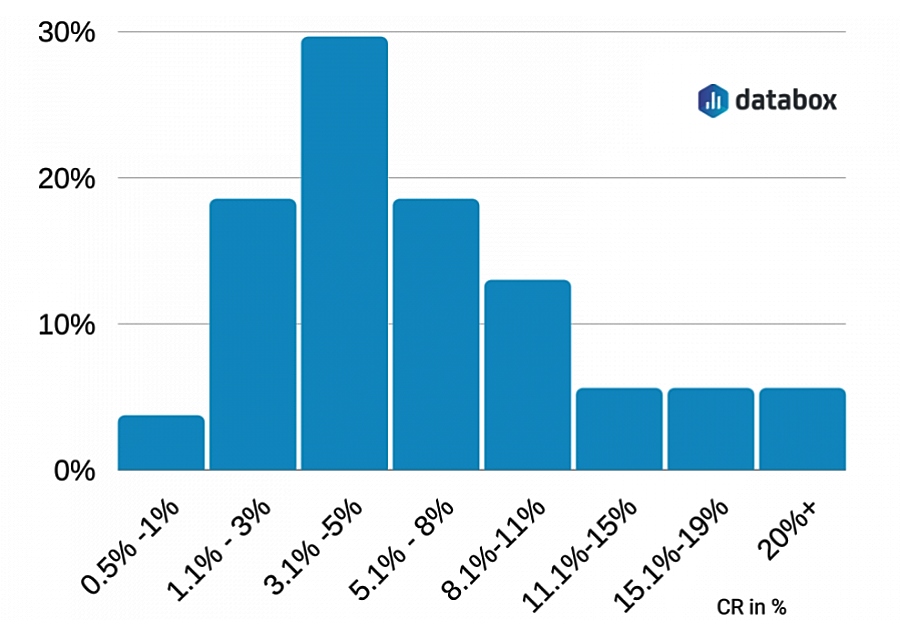
Read that for what it is: a survey of opinions, not a benchmark. Two things make it close to useless as a target for your business.
The first is that "funnel conversion rate" is not one number. Visitor to lead, lead to opportunity and opportunity to customer are three different rates, and people quote whichever one flatters them. Define which rate you mean before you compare yourself to anybody.
The second is that the rate depends almost entirely on how you got the traffic. A page fed by branded search and a page fed by cold social traffic can be equally healthy and differ by an order of magnitude. We do not set client targets from a survey of other people's opinions. We set them from the account's own history, then try to beat it. If you are not yet measuring per stage, start with the digital marketing KPIs that matter.
When a funnel is not worth building
Some honesty, because the answer is not always "build a funnel".
- If you could list every possible buyer on one page, skip it and call them. Content marketing exists for demand you cannot enumerate.
- If the bottom of your funnel does not exist yet — no clear pricing, no way to book, no follow-up on inbound enquiries — building awareness content is pouring water into a bucket with no base. Fix the bottom first, always.
- If you cannot answer "what happens next" for a piece of content, do not publish it. An asset with no next step is not part of a funnel.
- If your budget is genuinely small, do one stage properly rather than three badly. Usually that stage is the bottom.
How we build these for clients
We work at $95 an hour, month to month, with no contracts, so nobody is locked into a funnel that is not earning. Where paid media is part of it, our minimum ad spend is $500 a month, and below that there is not enough data to make decisions from. Seven of us, in Spokane, since 2026.
Half of a first call is usually spent working out which stage is actually broken. If it turns out the problem is your sales follow-up rather than your marketing, we will say so, and there is no reason for you to hire us.


Founder of Ernst Media. Fifteen years running paid search and paid social for small and mid-size businesses, and still the person who builds the audits by hand. Writes here about what actually moves accounts.